Faculty Mentoring Program

Mentoring conversations and reflections

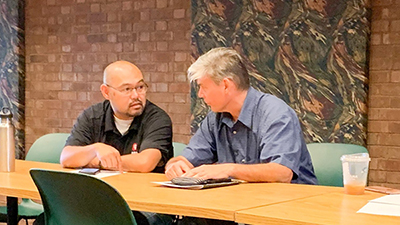
Professors Kathy Auberry and Kate Wills talk about how their interdisciplinary mentoring relationship has been professionally and personally rewarding. Dr. Wills, a Professor of English, mentored Dr. Auberry, an Assistant Professor of Nursing, on research writing. Their collaboration has resulted in a co-authored article titled "Improving medication practices for persons with intellectual and developmental disability" in the Journal of Intellectual Disabilities.

Description of the video:

Hello, I'm Kathy. I'll bury an Assistant Professor at the School of Nursing at IUPUI see. And hi, I'm Catherine wheels. I'm the Director of the English program and Professor of English at IU, PUC. And Kate and I are here to talk about our mentoring experience that we've had at IEPs. See, I can state from my experience with Kate, how valuable the mentoring experience has been. As a registered nurse, the profession does not necessarily prepare you for academia. My background was as a direct care nurse for people with intellectual and developmental disabilities and then later as Director of Health Services and director of operations. So having a mentor like K to help guide me through work that was so different than what I did before was extremely helpful. Every profession has its own nuances, languages, and processes. And so having experienced professor like Kate was instrumental in my growth as an assistant professor and also in developing my candidate statement in my dossier. So those are the things that were really valuable to me in the experience. Kate, What about you? Well, as a, as a mid-career faculty member, I began to feel the need to really energize my workplace relationships and even my productivity. So I joined the pure faculty mentoring bureau here at Columbus, Indiana at IUPUI see and I, I enrich my collegial relations, especially with Kathy if cross-disciplinary relationship. And I was so fortunate to be matched with Kathy because we brought fresh ideas to each other's teaching and our scholarship and we really clicked. We even co-wrote a much cited peer reviewed article. My academic labor just became more relevant to me too, as did my day to day casual exchanges on campus. Through the mirror peer mentoring experience. Oh, that sounds, that sounds so nice, Kate. Thank you. Talking about those things, I'm thinking about some of my biggest takeaways. And I think part of it is just how critical it is to have a mentor to help guide you through the challenges that you are going to face as a new faculty member. You want to become a re, a positive faculty member, respected by others and you really need that mentorship to help guide you. So additionally, having someone like you share both the challenges that I face, but also some of the successes was just really valuable to me. And so those are some of the takeaways that were important to me. I agree my biggest takeaway was just not to fear to work across disciplines, in my view, higher education, his favorite specialization. And this often leads to silos which in turn stifle creativity and vision. For me being a faculty peer mentor with you rekindled my humanities view that all disciplines are interconnected. Science are writing, communication, physics. I cannot help but think about Michelangelo. The application of the classical mathematical a golden ratio as, as he had designed and painted the Sistine Chapel. So in many ways it was just natural for for Kathy and need to stretch our disciplinary boundaries as we combine nursing practices and reflective pedagogy, it fit together very well. So I was, I was very pleased on multiple levels are a beautiful way to, to talk about our mentoring relationship. Because I feel the same way, but I have to admit the very beginning, I was nervous about cross discipline mentoring. Would you understand what I needed as a nursing professor? But we developed a wonderful report right from the beginning. And I have to agree with you that collaborating on our project that we did. And then later on a published article was just a highlight of the collaboration for me. Definitely highlight your knowledge and background. Bought brought a richness to the project that I don't think it would have had without your your additions in your knowledge base. So that was that was wonderful. And I also have to say, it's just been fun. You have a wonderful sense of humor. We've got to know each other personally. And it's, it's just been a very positive, valuable experience for me. Any other highlights for you, Kate, working across disciplines? I think you summarized it pretty well at the most important highlight for me in High Point was going the ongoing personal and professional relationship we have and the we sustain. And I know I can reach out to you at, for trusted advice professionally and within that campus academically. We share similar life experiences because we got to know each other and that was very comforting beyond the academic world. And yeah, we had that mentoring relationship, but I also found a friend. So that was good. I can't say everybody is going to find a friend, but I know we did and that's great When that happens at. And we also of course have be the co published article which was a big plug. So we collaborated, you and me and hearing shaver collaborated on the article that was published in Journal of intellectual disability to help nursing staff improve patient care with people with disability. So I'm really proud of that article and I'm proud we shared in that creative and intellectual article. Are mentoring relationship made it possible. I wasn't going into it expecting that. But, you know, when that just happened to flow out of our conversation, I was really pleased and I, I'm really proud, especially of that publication and that relationship in research and teaching. Thank you, Kate, I couldn't agree more. I just it was such a valuable experience for me and to have someone with your background and expertise share in that project. And that publication was was just one of the highlights of my career so far. So I really appreciate that. I think maybe we'll close with talking about advice we give to others. That might be considering being a mentor or a mentee. And I have to say from the mentee experience, I would just say that you need to be open. You need to be open to new perspectives that might be different from your own. And don't be afraid to expand that knowledge base that you have beyond your own discipline. Because that's where I think we affect the richness and a diversity that we weren't probably looking for, but found with that. And don't be afraid as a mentee to seek advice and ask questions. I always felt very comfortable coming to you asking for advice, knowing that I was going to get good, solid advice in that you are also invested in my success. And that was just meant the most to me. So that's kinda the advice that I would give others who were thinking about being a mentee. Yeah, I would agree. You really should experienced peer mentoring, being a mentor or a mentee and, and maybe both experiences and maybe it works out for you or maybe it doesn't. But I think you'll always wind up learning something and, and we are educators and it's good with me, educators learned something, so we always wind up learning something. And even if that is, you know, okay, this is great, but it's not for me. But I do have to say, and I honestly believe that this teachers and as researchers we mentor regularly and invisibly, I think that's what we do. And what this has really allowed us to do is to be a little more mindful and a little more intentional in our mentoring. In some ways to professionalize our mentoring and become more aware and conscious of how we are in those relationships, and what we contribute and what we gain. So it has really brought another dimension to mentoring that I think teachers and researchers all do. Wonderful, wonderful closure. I couldn't agree more. So from the bottom of my heart, Kate, thank you so much for being my mentor. I've enjoyed every moment of it. Thank you, Kathy. Thank you very much. I've enjoyed it and I'm looking forward to more mentoring experiences too. I am as well. Thank you very much. Bye-bye.
Dr. Nathan Rousseau, Associate Professor of Sociology, powerfully summarizes what makes for effective mentoring. Dr. Rousseau is the author of Society Explained: An Introduction to Sociology and the editor of Self, Symbols, and Society: Classic Readings in Social Psychology. His most recent publications include articles on the civil rights movement and on the encroachment of neoliberalism upon higher education. He is currently at work on his project, "Race relations in an emerging ‘Old South’ city,” funded by the IU Racial Justice Research Fund.

Description of the video:

Hello, my name is Dr. Nathan Rousseau and sociology and I am part of the mentoring program here. And I wanted to say a few things about the value of mentoring. And I'd like to do it in the form of using an acronym. The first letter that I want to use is the letter G. And what I mean by that is that the person that is doing the mentor has to be good at what they do. A good instructor, scholar, and have good social skills. So the first quality that are good mentor has, is they are good at what they do. The second quality is they are insightful. They are not just intelligent, but they are also insightful and they are able to share their insights with the mentee that they are working with. The third thing is they are feeling. And what I really mean by that is that they have empathy. They not only are hearing what you're saying with the mentee is saying, but they're actually listening what is being said. And they are able to guide the mentee in ways that they want to, to go. The final letter for this acronym is tough. A good mentor is like a good coach. And in that they, they kind of push you to succeed. They ask you to do sometimes difficult things. And that is preparation for the way the world really works. The if you put all those letters together, what you get is the word gift. What a mentor gives, or the gift that the mentor provides is basically information for the mentees success. And the gift that the mentee provides to the mentor is their achievement in the things that they want to be successful in. So good mentoring is a gift for both parties involved. Thank you.

Publications

Towers, George W., Poulsen, Joan R., Carr. Darrin L., & Zoeller, Aimee N. 2020. Mentoring for faculty from working-class backgrounds. Journal of Working-Class Studies, vol. 5, no. 1, pp. 101-118.
Download article


Towers, G., Poulsen, J., Zoeller, A., Crisp, C. & Torres, A. 2017. Diversifying for Sustainability: Repurposing a Targeted Pilot Faculty Mentoring Program. In 10th Annual Mentoring Conference Proceedings: A Decade of Cultivating an Inclusive Mentoring Community, eds. N. Dominguez, B. Berkeley, N. Barka, T. Chrisman, B. Kelley, & E. Westfall. Albuquerque: University of New Mexico.

Download article


Towers, G., Carr, D., Poulsen, J., Zoeller, A., Torres Bernal, A. and Crisp, C. 2016. Career Self-Efficacy Mentoring for Pre-Promotion Under-Represented Faculty. In 9th Annual Mentoring Conference Proceedings: Developmental Networks: The Power of Mentoring and Coaching, eds. N. Dominguez and D. Alexander, pp. 1222-1226. Albuquerque: University of New Mexico.

Download poster presentation